-
Elizabeth Barton, the Nun that Henry VIII executed

This nun had many names, The Nun of Kent, The Holy Maid of London, The Holy Maid of Kent and also The Mad Maid of Kent, but Elizabeth Barton was also the only woman who had her head placed on a spike on London Bridge.
At 19, Elizabeth began to predict the future and one of her prognostications was that leaving the Catholic Church would be a bad thing. The Catholic Church was rather happy to have this positive omen on their side and Elizabeth joined the Church as a nun. Word of her visions began to spread with thousands believing the prophecies and Elizabeth became quite the attraction for pilgrims.
Henry VIII heard about Elizabeth and her visions after she met with Cardinal Wolsey in 1528, meeting her himself twice and at first was very much on board. Her visions warned against heresy and rebellion, which at the time went along with Henry’s campaign against Lutheranism. However, by 1534 her prophecies were against the Reformation and the annulment of the marriage to Catherine of Aragon and when she told him that he would die and go to Hell if he got a divorce, he decided that he had gone off her.
At first the King’s agents helped to try and smear her reputation with false rumours of sexual relationships with priests and mental illness. Unfortunately, imagining the death of the King was treason and so Elizabeth Barton was eventually hanged on 20th April 1534. Henry VIII decided that he would make an example of her and put her head on a spike on London Bridge as a warning to others who dared to ponder or predict his death.
The body was taken to Greyfriers Churchyard in Newgate, where Elizabeth Barton was buried. several churches, like St Augustine of Canterbury still venerate Elizabeth Barton. In fiction, Barton also appears in the novel and TV series Wolf Hall.
-
Martin van Butchell’s Interesting Wife

Martin van Butchell was a quack dentist and all round ‘interesting chap’ in London, known for riding around on a white pony that was painted with purple spots.
His wife Mary died in January 1775 and he had her embalmed by his old teacher, the famous Dr William Hunter and Dr William Cruikshank. The body was injected with preservatives and colours, her eyes replaced with glass ones and she was dressed in a fine lace gown before being embedded in a glass topped coffin using plaster of paris.
Butchell then placed the whole coffin ensemble in the window of his home, which was also where he practised dentistry. There was a rumour that a clause in the marriage contract provided income for Butchell while Mary was ‘above ground’, though this was possibly started by Butchell himself.
When Butchell remarried his new wife demanded the infamous and slowly decaying previous wife be removed. She was given to Dr Hunter’s museum.
Mary Butchell finally found peace when a 1941 German bombing raid blew the museum, and her, to bits.
-
An Overly Fatal Execution (1807)

John Holloway and Owen Haggerty were hanged on 23rd February 1807 at Newgate prison for the murder of lavender nursery owner John Cole Steele. The pair were convicted on circumstantial evidence as well as a testimony from Benjamin Hatfield (who’s transportation sentence was then dismissed) and many thought them innocent or at least unjustly condemned to death.
The morning of the execution attracted a crowd of over 40,000 people outside the prison and they covered the nearby area trying to get a good vantage point to view the scaffold. They climbed up lamp posts, onto nearby window ledges and rooftops and up onto carts.
As part of his last words John Holloway stated to the crowd
Gentlemen, I am quite innocent of this affair. I never was with Hanfield, nor do I know the spot. I will kneel and swear it.
At around 8.07am the executioner released the hatch below the prisoners and they dropped to their deaths. There was a surge forward of the crowd and near Green Arbor Lane a cart collapsed, crushing those falling from it as others tried to escape. The pushing hordes of people also knocked over a pieman who dropped his basket of pies, causing others to also fall.
It took around an hour to clear away the crowds so authorities could check on the dead and wounded. The injured were taken to St Bartholomew’s hospital. According to the Star newspaper at the time
…the number of the unfortunate persons trodden to death amounts to no less than thirty-two! Twenty-four men, three women and five children were the unhappy sufferers.
The dead were taken to nearby churches and public houses to be laid out awaiting identification by loved ones.
-
Crossbones Graveyard

Crossbones Graveyard lies tucked away near Borough Market, the final resting place of an estimated 15,000 paupers, amongst them are the Winchester Geese.
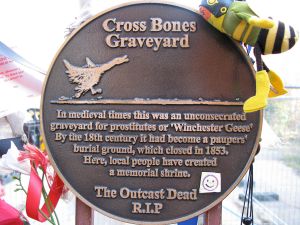
Image: ProfDEH The Winchester Geese were prostitutes that worked in the area around Winchester Palace, the residence of the Bishop of Winchester. From the 12th to the 17th Century, the prostitutes of the area were licensed by the Bishop, however were refused a Christian burial. Crossbones Graveyard is unhallowed ground.
“I have heard ancient men of good credit report, that these single women were forbidden the rights of the Church, so long as they continued that sinful life, and were excluded from Christian burial, if they were not reconciled before their death. And therefore there was a plot of ground, called the single woman’s churchyard, appointed for them, far from the parish church.” John Stow, Survey of London 1598
Other people that were denied a Christian burial, such as criminals and the very poor began to also be buried at Crossbones Graveyard. By the nineteenth century, the area around Crossbones Graveyard had become one of the worst slums in London. The cholera epidemic spread through the slums with ease and the body count was high, rapidly filling Crossbones Graveyard and most others.
Due to the increasing threat to public heath, in 1851 an Act was passed that closed many graveyards, including Crossbones in 1853. Burials were moved to large purpose build cemeteries outside of the city and Crossbones Graveyard fell into disuse and became almost forgotten and ignored.
In the 1990s, the Jubilee Line was extended and an electricity sub-station needed to be built, so archaeologists from Museum of London were called in to check the site. They excavated 148 bodies which was estimated to be around 1% of the total number buried at Crossbones Graveyard.
Inspired by a vision, writer John Constable rediscovered the Crossbones Graveyard, now in a dilapidated state and created the Friends of Crossbones to tend and care for it. In 2007, they held a rededication ceremony at the now cleaned up and replanted Crossbones Graveyard.
To find out more about Crossbones Graveyard and Friends of Crossbones, check out their website at https://crossbones.org.uk/
Opening Hours: Wed to Fri – 12-2pm
Transport: London Bridge Station
Address: Union St, London SE1 1SD
-
St Bride’s Church and Charnel House

St Bride’s Church and Charnel House was part of the rebuilding of London by Christopher Wren following the Great Fire of London in 1666, but it held a secret until the 1940s.
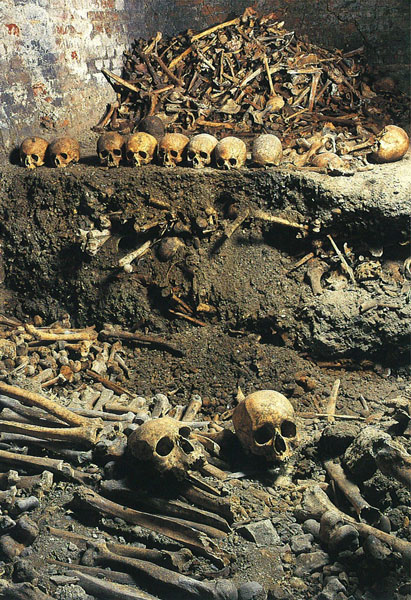
credit: stbrides.com The Blitz rained terror on London during the Second World War, but the 29th December was the night St Bride’s Church was hit. Thankfully the building was empty at the time, though the roof timbers caught alight and by morning only the walls and spire were left standing.
The 1950s saw services reappearing on the site and a restoration fund was set up by the new Rector Cyril Armitage. The restoration work uncovered Roman remains, but also long forgotten crypts filled with the remains of thousands of victims from the Great Plague of 1665 and the cholera epidemic of 1854. With the crypts overflowing, Parliament put an end to burials in the City and the crypts were locked up for good.
The rediscovered medieval Charnel House was found to hold nearly 7,000 human remains, mostly grouped into body part ‘categories’ in a checker-board pattern. The bones would have been moved from their original burial locations to free up space due to land shortage in London.
If all that wasn’t enough, the church also has a memorial to Jack the Ripper’s first known victim, Polly Nichols, a Victorian casket from the era of ‘body snatching’ and the Journalists’ Altar commemorating all the journalists and media staff that have died in conflicts.
Due to the age of the building there is only step-free access to the main body of the church, via the west door. Access to the crypt requires using 20 steps, also the floor of the crypt itself is understandably uneven due to age.
Opening Hours
- Mon – Fri: 8am – 5pm
- Sat: 10am – 3.30pm
- Sun: 10am – 6.30pm
Bus: 11, 15, 26, 76 and 341 stop on Fleet Street
Tube: St Paul’s (Central Line) and Blackfriars (District & Circle Lines)
Address: St Bride’s Church, Fleet Street, London, EC4Y 8AU
Website: https://www.stbrides.com/
 Darker London